Selecting an American-curriculum school is often driven by clear goals: strong English instruction, a broad subject offering, continuous assessment, and pathways that support international university admission priorities commonly associated with best American curriculum schools in Ajman. In the UAE, however, families also expect schools to preserve language, identity, and values in a way that is academically credible, not superficial. At CAS, Arabic and Islamic Studies are designed to meet that expectation while complementing an American-curriculum learning model that prioritises skills, performance, and measurable progress.
This article outlines what students and parents should reasonably expect academically, culturally, and developmentally and how students can gain the most from these subjects.
Arabic Studies: Language Development With Academic Purpose
Arabic at CAS is not intended to be a “heritage subject” taught in isolation. This is a structured language program with clear logic. It develops reading, writing, speaking, and listening comprehension. In the lessons, they work with texts by age, expand the vocabulary and study grammar in a live context. The letter is being processed gradually. Precision and clarity are formed over time. This is exactly the purpose of learning. One thing is important for students to understand. Arabic is seen as a learning tool, not as a memory exercise.
The result is formed through regular practice and active participation. Slowly, but steadily. Students who take language seriously as a skill tend to achieve better results. Students can support their success through practical routines: Read short Arabic passages daily, even five to ten minutes, to strengthen fluency.
- Maintain a personal vocabulary bank (digital or notebook-based) with example sentences.
- Practise speaking through structured prompts rather than informal guessing.
- Ask for feedback on writing, then apply it in the next task.
These habits create steady improvement and reduce exam anxiety because the student’s performance is built over time, not “saved for the test.”
Islamic Studies: Knowledge, Values, And Application
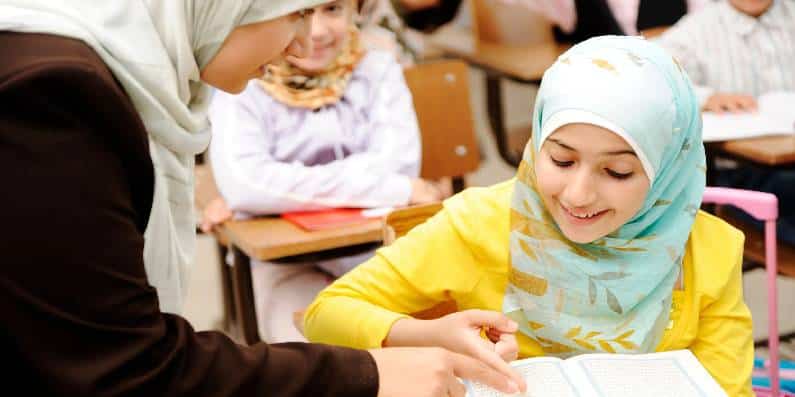
Islamic Studies at CAS is designed to build both understanding and practice. Students should expect learning that connects foundational concepts Qur’anic guidance, Prophetic teachings, and Islamic ethics to daily decisions and responsible citizenship.
High-quality programs in Islamic disciplines are not limited to memory testing. They require understanding. Students reflect, discuss, and put knowledge into practice. This is how a conscious attitude is formed.
This format supports personal growth and respectful behavior in the school environment.
For students, the key point is simple, but fundamental. The Arabic language here is a tool of thinking, not a mechanical memory. The result depends on engagement and constant work. Step by step. Students who perceive Arabic as a full-fledged language of instruction tend to develop noticeably faster.
Students can strengthen outcomes by:
- Preparing short reflections (even a paragraph) on values discussed in class.
- Connecting lessons to real situations: social media use, friendships, honesty, responsibility, and service.
- Practising Qur’an recitation consistently (small amounts, frequently).
How These Subjects Fit The American Curriculum Model
The American educational model is based on standards and clear goals, a structure widely recognised across American curriculum schools in UAE. Each stage of training has a measurable result. The student’s work is evaluated regularly: through projects, assignments, short checks, and final papers. Nothing is solved in one day. This is fundamentally important for families. The child’s development is monitored systematically and without the pressure of one crucial exam.
At CAS, Arabic and Islamic Studies align with this approach. Students should expect:
- Regular formative assessment (class tasks, short checks for understanding)
- Skill-based practice (reading, writing, communication, application)
- Feedback cycles that allow improvement across the term
This consistency matters. When Arabic and Islamic Studies are delivered with the same expectations as other subjects, students take them more seriously and progress becomes more visible and measurable.
What Parents Should Look For (And What To Ask)
Parents can assess programme quality by focusing on evidence rather than promises. Useful questions include:
- What language tracks are offered (native/non-native), and how are students placed?
- How is student progress measured across the term (not only at the end)?
- What types of student work are produced (writing samples, projects, presentations)?
- How does the programme support values and behaviour in school life?
The strongest programmes also communicate clearly with families about objectives and expectations. A consistent home–school partnership is particularly important for language development and Qur’an learning.
What Students Should Know Before The Term Begins
Students benefit most when they enter with the right expectations:
- Arabic and Islamic Studies require active participation, not passive attendance.
- Progress is built through small, frequent practice.
- Skills gained here support performance in other subjects especially reading, writing, presentation, and self-discipline.
The Arabic language and Islamic disciplines at CAS help to form a complete personality of the student. He learns to think strictly and clearly. And express yourself confidently. The school operates according to international standards. But it does not blur the roots. These subjects keep in touch with language and identity, as well as provide practical skills for university and adult responsibility.