Parents regularly ask when bilingual development should begin. Some believe it starts when formal reading instruction begins. Others assume that living in the UAE is enough and that children will naturally absorb both English and Arabic without structured support.
Language development begins in the earliest years of life and progresses rapidly during this period. It does not wait for the start of formal schooling. The early years are when language patterns are established and reinforced, and in many cases, these patterns become long-lasting. Children’s early experiences with language influence not only how they communicate, but also how they process information and learn as they grow.
Our City American School, bilingual development in English and Arabic is approached with clear intent and structure, recognising that the early years offer limited opportunity for later correction.
Why Early Language Development Cannot Be Delayed
From birth to around five years of age, children acquire language in a way that does not repeat later in life. During this period, the brain responds instinctively to sound patterns, vocabulary, and structure. Language introduced early becomes natural rather than academic.
This early foundation plays a critical role in preparing children for the demands of an elementary curriculum, where listening comprehension, reading readiness, and clear expression are essential for success across subjects.
Children exposed to more than one language early do not translate internally. They process meaning directly. Over time, this supports stronger attention, memory, and flexibility in thinking. These are skills that affect learning across subjects, not just language lessons. Once this window begins to close, language learning becomes more effortful and less intuitive.
English And Arabic Serve Different Purposes
In the UAE, English and Arabic each play a clear role. English supports access to international curricula, higher education pathways, and global communication. Arabic provides cultural literacy, identity, and connection to the wider society.
These roles do not compete. In practice, children who develop confidence in one language often progress more smoothly in the other. Understanding how stories work, how ideas are organised, and how meaning is expressed transfers across languages. Balanced bilingual development strengthens overall communication.
A Common Misunderstanding Among Parents
Concerns about confusion or delayed speech are common. They are also understandable. However, they are not supported by educational evidence. Learning two languages does not delay development. Children may mix languages, pause more often, or favour one language in certain situations. This is typical and temporary. What causes difficulty is inconsistency, limited exposure, or treating one language as less important than the other. Children need stability, not pressure.
What Families Can Do At Home
Supporting bilingual development does not require formal lessons or correction. In fact, overcorrection often has the opposite effect.
Three factors make the greatest difference:
- Clear routines: Children benefit when language use is predictable. This does not need to be rigid, but it should be consistent.
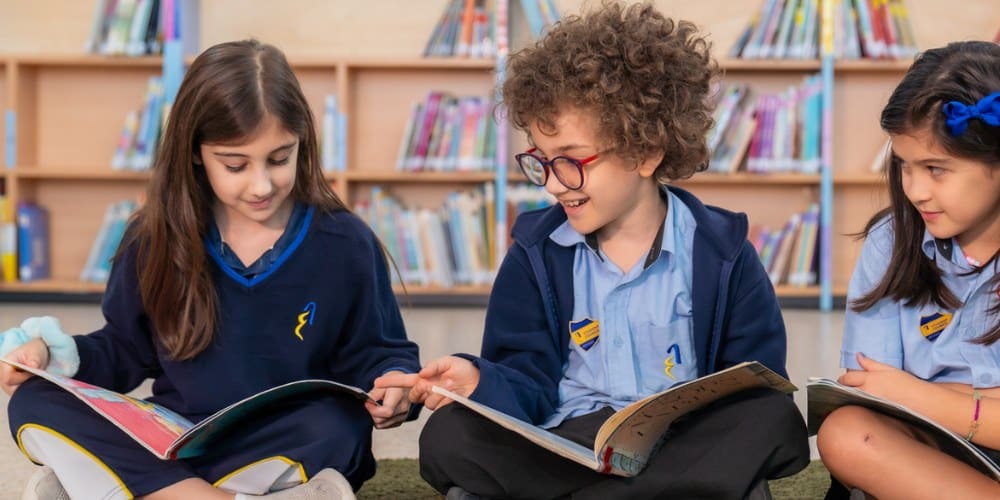
- Real interaction: Conversation, shared reading, and everyday communication matter far more than repetition or passive listening.
- Emotional security: Children speak most confidently in the language they associate with comfort and connection.
How City American School Supports
Bilingual development requires clear structure and consistent practice. At City American School, English and Arabic are part of everyday learning rather than taught as separate or isolated subjects, in line with the American Curriculum.
Language is used naturally during play, classroom discussions, inquiry activities, and social interaction. Children are encouraged to speak freely and without concern about making mistakes. Teachers observe language use closely and adjust their support to meet individual needs. This approach reflects how children develop language through experience and use.
The Lasting Impact Of Early Bilingual Learning
Children who are exposed to more than one language in the early years often enter school with a greater sense of confidence. They generally adjust to classroom routines more smoothly and participate more readily in lessons and group activities. The benefits of bilingual development extend beyond academic learning. Language plays an important role in how children interact with others, engage in classroom life, and begin to understand their place within the school community.
Bilingual development is not intended to push children ahead or shorten childhood. Its purpose is to establish a clear and stable base for communication. Over time, this foundation supports learning and understanding as children mature. When schools and families take a consistent and thoughtful approach, children are not pulled between languages. They develop both with confidence and purpose.
At City American School, our responsibility is to ensure that language supports learning from the earliest years, providing children with the tools they need rather than barriers they must overcome. Families seeking admission to the school can speak with our admissions team for school admission form and learn more about our early years language approach.